I’m Black
TSHIFHIWA ITAI RATSHIUNGO
Originally Published: 10 October 2026
in the past 6 years, i’ve had to exist in spaces that reject my Blackness and my queerness. spaces that require me to be malleable to the whims of patriarchy and white capitalist sensibilities. to dress a certain way, to be less confident, less comfortable, and less conscious of who i am.
to be palatable.
sometimes we are caught by the allure of the rewards of being in spaces that require us to be less of ourselves in order to belong. they praise us for how well we’ve assimilated to a point where we may begin to feel somewhat better than people who look like us but don’t have the same privilege and access. it gives you a false sense of worth. a false sense of belonging. a false sense of value.
and the truth is, sometimes it feels inevitable because i’m trying to build a life for myself. i’m trying to climb the ladder, to get my piece of the pie, to move beyond merely surviving. for me, there’s nothing wrong with wanting financial security and upward mobility. the danger is forgetting myself in pursuit of it. because at the end of the day, no matter how many rooms i may be able to enter, i’m still Black. i’m still queer. those are identities i cannot divorce myself from. neither do i want to.
for the Myself project, i’ve chosen to share a selection of poems from a work-in-progress collection titled “My Country Is Black”. this collection was born out of those contradictions. i exist in an African country where i, an African, am too often structurally disregarded and constantly need to shapeshift to fit into certain rooms. rooms where i need to be tamer, speak less, ignore the subtle racism, be more of a man (or whatever that is), and smile as i sit at the big table where i’m served crumbs but expected to feel as satiated as everyone else.
My Country Is Black is an attempt to strip myself of that illusion. to go on a journey of unforgetting. to draw myself closer to who i am. to create art that reminds me of the state, the condition, the joys, the realities, and the sheer blessing of being Black. poems that wrestle with what we inherit—from our families, from our histories, and from the country we call home.
it is not in an attempt to define the Black experience or queerness. if anything, i’m trying to resist that. this is my way of painting a kaleidoscope of us through voices informed by who i am, the people i know, the good, the bad, and the ugly. i want these poems to evoke pride, questioning, discomfort and tenderness. to paint an honest picture of our realities. of my reality. to leave enough room for contradiction because contradiction, i believe, is part of the experience too.
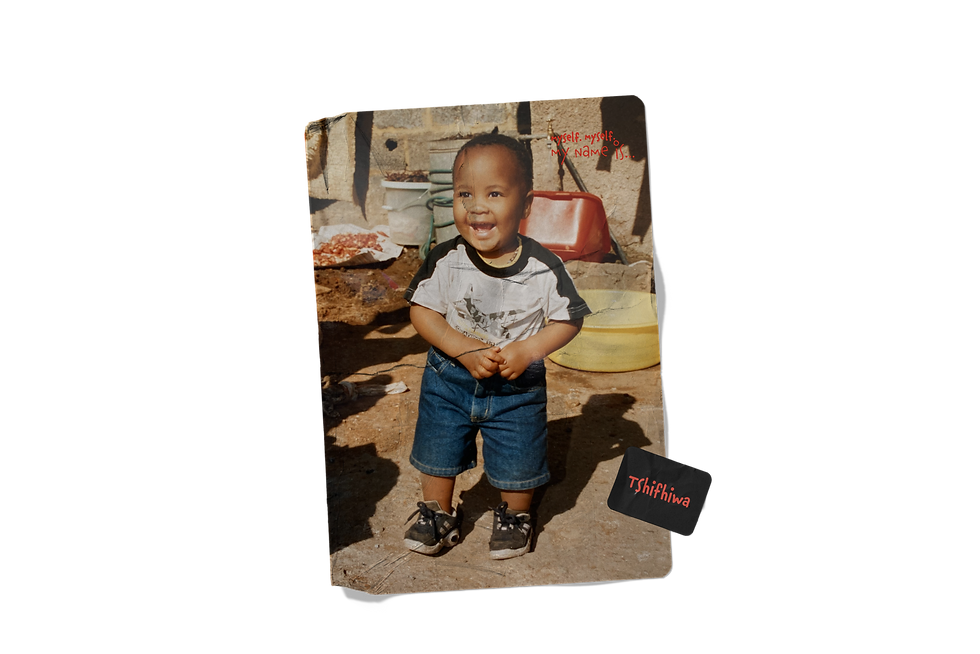
but stripped of any metaphor, if i had to answer the questions of who i am and who i want to be, i’d simply say this:
my name is Tshifhiwa
i was born in the year 2000
i am Black and i am proud
i currently live from paycheque to paycheque
when i grow up, i want financial freedom
and i hope i recognise myself when i get there
Excerpts from
“My Country Is Black”
Miss Black
i hear them say, the face of poverty is Black
but still they’ll say, Black is beautiful
she loves her hair
loves her skin in cocoa butter and glycerine
be Black and be proud
climb the ladder
break the ceiling
be anything but poor
still poor
still poor
you’re still poor
still fighting for your dreams
for that chair
for that space
you’re holding space huh?
for hurt feelings
and i’m sorry’s for not being sorry
sorry you had to speak up
sorry it wasn’t your turn
sorry you have a voice
i’m sorry we can’t hear you
still?
still
i hear them say the face of poverty is Black
but no one admits, who gave poverty a face?
return soldier
she grieved the grieving of him away
but the body could not forget
the things she had done for this man
look at her gathered belly she learned to love it
the wrinkles eluding her age her beauty
voluptuous waist she learned to love it
his loving made her form
through three children the three of hers
she grieved the grieving of him away
more than any dowry’s worth
more than the shame of turning homeward
carrying three breathing memories
more than thoughts of killing him
take what’s hers that he gave to another
pelt him with fists
splash him with boiling water
or would a knife teach him?
stab his back like he did hers
scar his face for every mirror to remember
or when his other asks what happened there
feeling the scar gently
after they’ve shared each other on her bed
laying on his chest
looking at the face she made ugly
raisin on a high horse
entlek, where did Joe disappear to?
argh! daai man. he got himself a fine diamond
a diamond in diapers, you wonder
she’s probably the same age as your eldest daughter
your voices louder than the music
billiards rolling as the drinks flow
a woman is a woman, they say
you can’t really change that, man
they mock the vim you’ve lost
to chase fresh blood like a hungry dog
an old timer like you? what would you do
with a straat meid? you retort
take a shot and hit the eight ball
i bet your daughter is sucking
the last juices of an old grape like Joe
haibo, don’t play like that man!
the laughter cuts quick
she’s not much of a cheesegirl is she?
you throw a punch
you can’t really change that, man
and as you walk away
you think of the woman who bears
the burden of your broken marriage
twenty years your junior
once the finest cherry, black diamond
and you? a raisin on a high horse
of women and rice
on Monday, shiny faces in uniform
and ten rand slipped into sister’s tunic.
mama helped us write our homework.
mama signed the letters in her name.
mama knew best.
she left early and came back late.
Saturdays, men and derbies.
Sundays, women and rice
packed for Monday’s lunch.
sometimes, Saturdays were too late
to spring clean for the coming family feast—
a stokvel in mama’s name.
and there, mama slaved.
tended the braaing men.
chided the fighting children.
hid uncle’s brandy.
heard us call her name.
mama this. mama that.
mama why? why did he leave me?
children once christened by now heathens
wore tiny suits and gowns on Sundays.
mama stayed in the house to rest.
mama cleaned on Mother’s and Father’s Day
dreading drunken derby arguments in her yard
while she made a plate for even that man
who hasn’t brought back the money
uncle took from mama’s wallet.
Sundays, for women and rice
men rolling dice on the ludo painted on the tar.
somewhere in this warped history of a romantic struggle lies the truth*
mother hears us sing asina mali
and remembers
father returned a bruised man gleaming with hope
and remembers
the struggle is not far from yesterday
and the policeman skin of her skin
who commanded “dompas”
and she did not rattle as he flipped through it
and her suitcase murmuring “Jehova’s witness”
while father dug diamonds for the man
held its worth in the palms which slapped music from his gumboots
mother carried around the good news in the watchtower
working men will never dishearten when they work
singing sombrely the dream of hope: tomorrow morning
while father broke rocks in prison
mother sent the children to school
she hurried the firstborns out of katlehong
she saw to it he escaped the borders
and kept the vinyl of the songs no one was afraid to remember
she toured the houses from street to street to vilakazi
evangelising “tomorrow morning” hidden in the watchtower
when the hopes of many dwindled when many died
when the hopes despaired when many were buried alive
a bloodbath of youths martyred before they could taste this rainbow
we strike tomorrow morning
we fight tomorrow morning
freedom is tomorrow morning
tomorrow morning becoming a story of soon
father stepped into power in the colours
of a bruised man gleaming with hope
he vowed land tomorrow morning
and so did his descendant
and his descendant
and his
the country is stolen in blood money
we her great and grandchildren beg men wearing freedom’s colours
for land belonging to a people who suffered from nothing of their fault
we still cry the plight of their betrayal: thina sizwe
in freedom colours struggled into power
we forget the meaning of yesterday’s sacrifice
we forget the struggle is not far from yesterday
wearing school uniform to taverns irreverently
commemorating the sacrifice of youths who died for learning
as youths today have died for learning
it is easier to forget when these stories are omitted and left to romantic imagination
/ these realities are silent from the mouths of men and women who bruised and gleamed
with hope toiling for this land / they do not want to remember what they can still see:
tomorrow morning is a story of soon
*Initially published in Yesterdays and Imagining Realities: An Anthology of South African Poetry (impepho press) and translated into French.
requiem for the beautyful ones
After “The Beautyful Ones Are Not Yet Born” by Ayi Kwei Armah
my beautyful ones were born queer
gurls who intoned a psalm for gurls who love gurls
because gurls know God too
my beautyful ones never lived in fear
they made space for gurls like me
to walk the walk too
i love my gurls because they loved me first
they loved my lover and loved the life we could live
they made our dignity sacred in law
so no man could tear us asunder
they danced and burnt the world
to see us for who we are
and called us their children
before we were yet born
our lives are a benediction to their stride
our voices are hymns for their pride
our laughter
praises unto their sacrifice
our joy
an endless requiem for their beauty
ave pulchrae, gratia plenae, Domina vobiscum
ave pulchrae, gratia plenae, Domina vobiscum
ave pulchrae, gratia plenae, Domina vobiscum
The Creative
TSHIFHIWA ITAI RATSHIUNGO
Tshifhiwa Itai Ratshiungo (he/him), Co-founder and Artistic Director of NUMXN, is a writer, creative and cultural worker from South Africa. He is also the Editor-in-Chief of Numen of Story, a NUMXN initiative. His written work interrogates and explores themes of identity, memory, and Black history to evoke intergenerational conversations on language, culture and being. Among his notable achievements is having been a part of an arts advocacy movement which galvanised the South African government to provide relief funding to creative practitioners during covid-19 lockdown. He has also been published in initiatives powered by the European Union, Goethe Institut and French Institute of South Africa, among others.